
Advanced Technology Proving Ground Accelerates Grid Resilience
“What’s unique about the ATPG is that we can provide an at-scale, real world environment testbed that does not exist elsewhere.” – Rob Hovsapian
Savannah River National Laboratory aspires to be the premier national laboratory in pursuit of meeting the nation’s biggest scientific challenges. Among the Department of Energy’s priorities is energy resilience; in particular, the resilience of the electrical grid. To ensure everything from the lights coming on when Americans flip a switch to the country having the energy needed to defend itself and project power, the U.S. must counter threats from nation states, non-nation states, extremists and natural phenomena like storms.
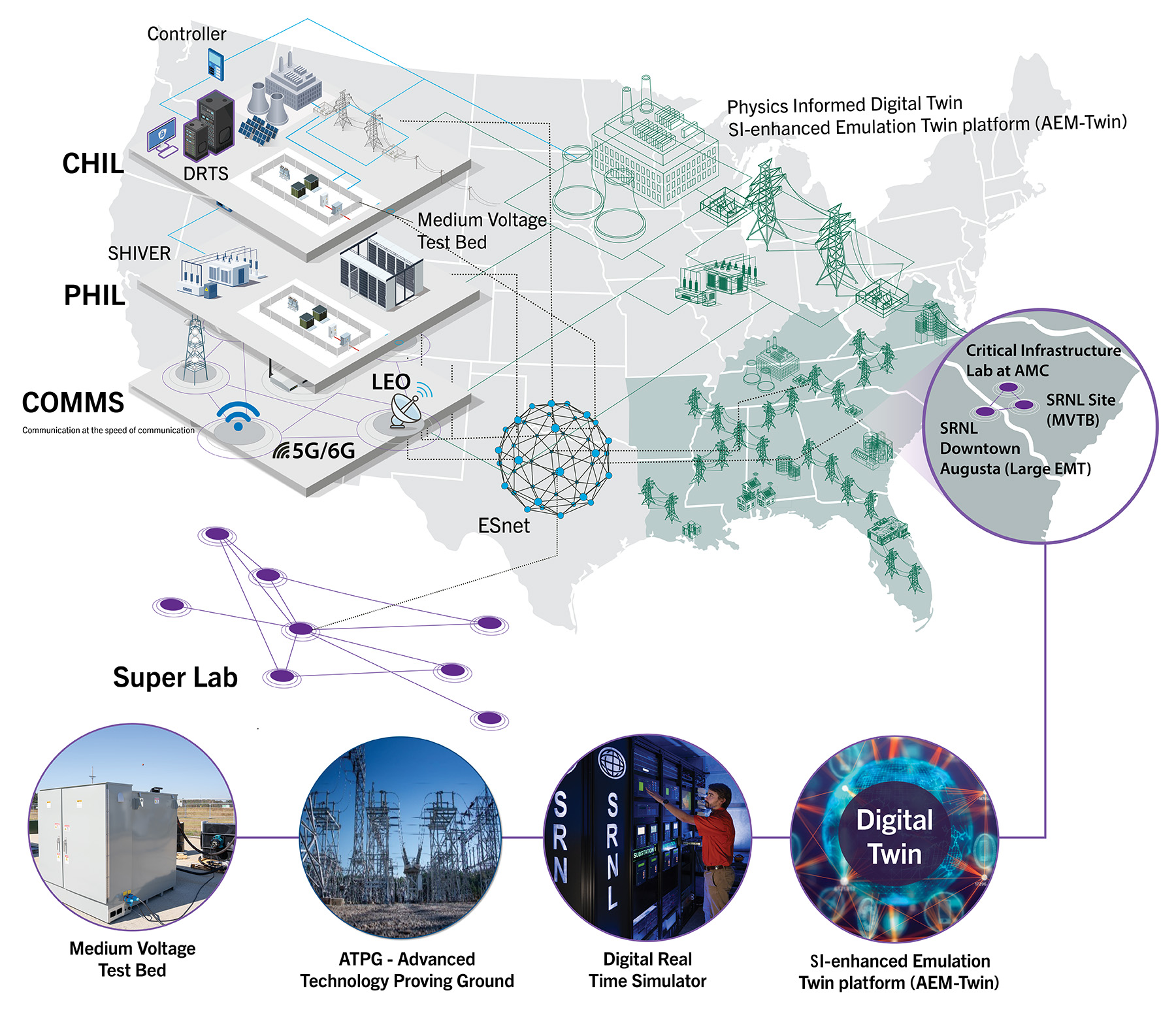
SRNL is uniquely positioned to tackle this challenge through its Advanced Technology Proving Ground, located on the 310-square-mile Savannah River Site in South Carolina. The ATPG comprises three primary test sites. The first is P Area, which hosts the Open-Air Experimentation Range. The second is C Reactor (105-C), designated as the Zero/Low Observable Experimentation Facility. Together, these two sites provide premier research, development, test and evaluation environments for chemical, biological, radiological and nuclear defense; unmanned/counter-unmanned systems; and radiofrequency-denied experimentation.
The ATPG’s third test site, the Savannah River High Voltage Experimental Range, or SHIVER, will serve as a dedicated resource for grid resilience research, with initial operational capability slated for 2028. Once complete, SHIVER will provide an extensive, isolated, high-voltage test bed featuring 34 miles of instrumented power lines, including 17 miles rated up to 115 kilovolts. While comparable facilities exist nationwide, only the ATPG will offer the high-voltage operational environment necessary to perform critical research at operational scale.
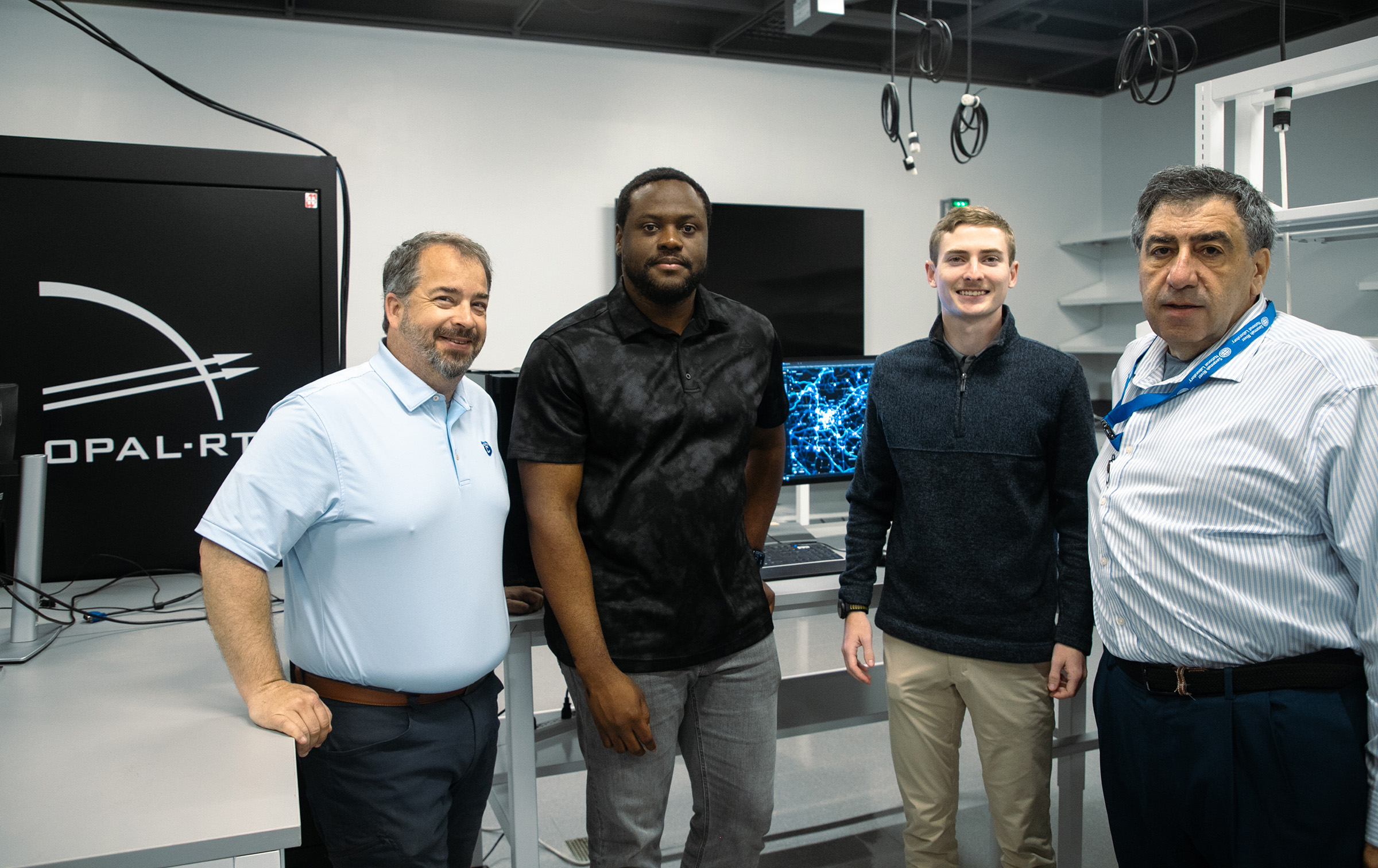
SRNL has also assembled a top-notch group of scientists to study grid resilience. Rob Hovsapian joined the team last year from the National Laboratory of the Rockies as senior research fellow in the new Science, Energy and Innovation Directorate. Hovsapian is a nationally known energy researcher with decades of experience in the energy industry and the national laboratory system.
“We start by looking at the fundamental physics involved – if we start there, we can design a much better, more resilient grid,” said Hovsapian. “And what’s unique about the ATPG is that we can provide an at-scale, real world environment testbed that does not exist elsewhere.”
The testbed is also using super intelligence and Machine Learning to generate data to prevent disruptions in the grid. Lightning strikes and other natural scenarios can be simulated, thus training the SI algorithm. This facilitates the development of advanced grid controllers that can self-learn and act quickly to minimize problems. Having access to both the transmission hardware and grid controlling hardware, combined with the SI/ML capability, gives the ATPG additional research advantages.
A central part of this work is a new SRNL platform called AEM-TWIN, an SI-enhanced emulation digital twin. AEM-Twin creates a high-fidelity virtual replica of the grid that runs in real time and is wired directly into the ATPG’s physical equipment. Through two complementary techniques, Controller-Hardware-in-the-Loop for grid control systems and Power-Hardware-in-the-Loop for power equipment, actual hardware can be connected to the digital twin and operated as if it were running inside the live grid, without putting the live grid at risk. This combination of real hardware and AI-driven simulation is what allows SRNL to recreate real-world conditions in a controlled laboratory setting.
This novel integration of SI/ML resources and hardware also allows SRNL to partner with experts across the national laboratories who specialize in specific aspects of the power grid. In prior projects, Hovsapian has connected with various assets from other labs. He refers to this dynamic team approach as the Super Lab. This approach is the goal for the ATPG initiative at SRNL.
“Not only are we replicating the real word environment but through this integration we are also engaging our multi-disciplinary team here and across other national laboratories,” added Hovsapian. “This will also help us accelerate innovation.”
The team is deploying quantum computing in addition to the SI aspects of the grid resilience experimentation. Quantum computing to optimize grid operations and balance electrical loads is another new scientific frontier. This quantum-in-the-loop concept greatly enhances the computing power SRNL can bring to bear.
Other, recently-opened SRNL facilities are also contributing to the grid resilience effort. The Advanced Manufacturing Collaborative, located a few miles from the main lab on the University of South Carolina Aiken campus, serves as an innovation incubator where SRNL partners with government, industry, and academia to develop and scale solutions to real-world challenges. With state-of-the-art lab space and equipment, the AMC complements the ATPG by giving SRNL a place to prototype and refine new grid technologies.
“Rob Hovsapian and his team are top notch and poised to make great strides in this field,” said Roderick Jackson, associate lab directorate for SEI. “The combination of the ATPG, AMC and rest of SRNL’s resources provide an excellent foundation for innovation.”
The lab’s combination of technologies, facilities and scientists positions it to achieve its goal of solving one of the nation’s biggest challenges. SRNL’s diverse grid resilience assets and great minds are raising the lab’s profile in this national priority and beyond.