
How Savannah River National Laboratory Supports Additive Manufacturing
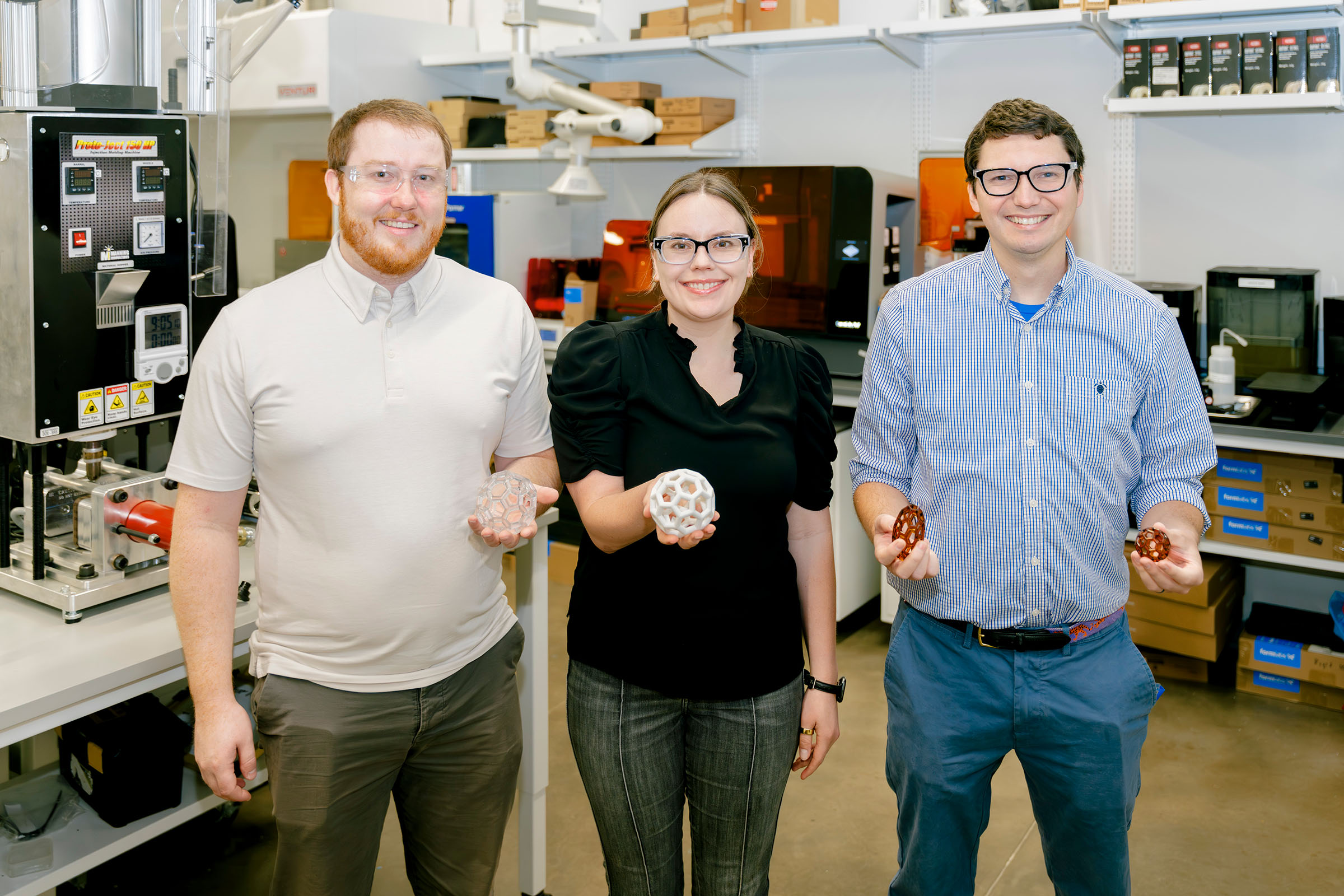
Additive Manufacturing (AM), commonly known as 3D printing, was once a futuristic tool seen in movies like Ocean’s 8 or Jurassic Park, used to instantly replicate and print on demand. AM has now emerged as a groundbreaking technology that is changing how different industries respond to traditional manufacturing methods. SRNL researcher Samuel Leguizamon has taken that tool of the future to help transform how SRNL puts science to work, enabling entirely new capabilities that were previously impossible using traditional methods.
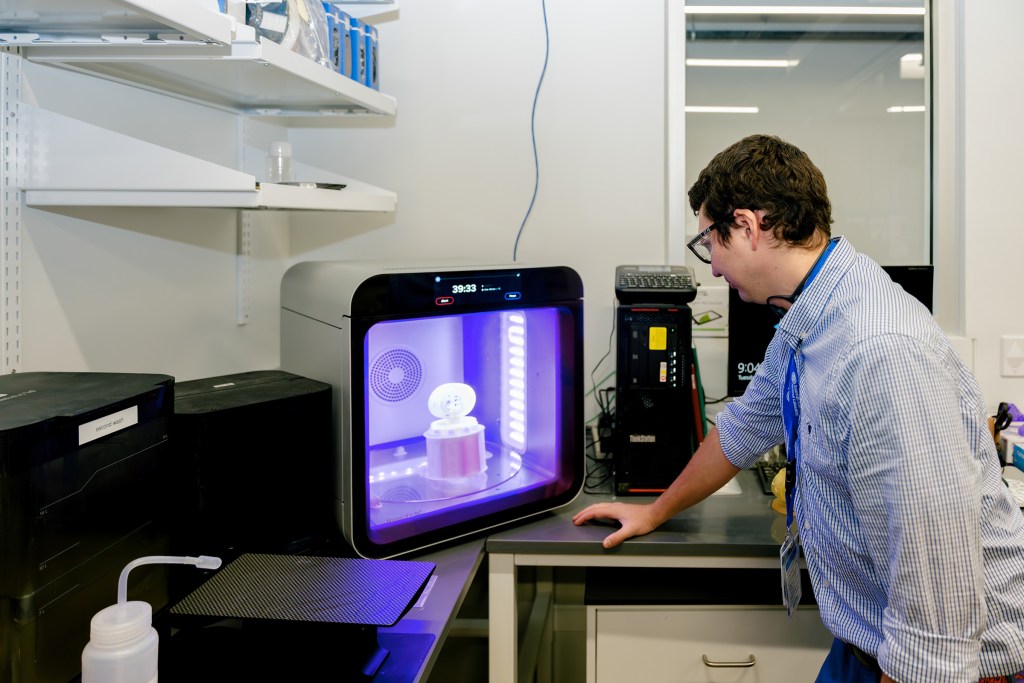
AM is a production process that creates objects by depositing materials on top of one another, based on a digital design. Unlike traditional manufacturing methods, that remove material to achieve a desired shape through cutting or drilling, AM builds objects layer by layer, offering greater material and energy efficiency and reduced waste. AM uses a variety of materials, including plastics, metals, ceramics and others to enable rapid prototyping of complex geometries or material blends that are difficult to achieve using traditional methods.
One of the most significant advantages of AM is design flexibility. AM allows for increased functionality in parts by enabling design freedoms that are impossible with traditional manufacturing methods. Engineers can create lighter, stronger and even more efficient components by manipulating design elements. “Being able to quickly develop and alter prototypes as we see fit is a key asset of AM,” said, Leguizamon. “We can develop prototypes and analyze iterations faster than you can with traditional manufacturing. We can design and test same day and incorporate redesigns quickly.” This critical aspect of AM proved essential for the SRNL AM team when approached to replace the traditionally used scintillator disks for H-Canyon after the original manufacturer discontinued production. As the only operational radiologically shielded chemical separations facility in the United States, H-Canyon relies on scintillator disks to detect radiation in process water. Drawing on its in-house expertise, SRNL swiftly designed, prototyped, and refined disks using a variety of material compositions, successfully matching the light output of the legacy disks while also introducing new capabilities to optimize detection performance for future needs. Although SRNL is not yet equipped for large-scale production, the lab excels in producing small batches of high-quality components that match the functionality of those made by industrial manufacturers. This streamlined process significantly accelerates the development and refinement of designs. By utilizing its comprehensive in-house material characterization suite, SRNL ensures the reliability and performance of every part produced. Additionally, SRNL collaborates closely with stakeholders, customers, and partner laboratories to uphold the highest standards of quality and standardization.
For SRNL AM is more than a tool, it is a strategic capability integrated across the lab’s mission areas. From rapid prototyping to functional part production, AM is accelerating the pace of discovery and deployment. AM increases the efficiency of fusion fuel fabrication and allows researchers to produce complex fuel targets that are critical for enhancing energy output, yet difficult to create using traditional methods.
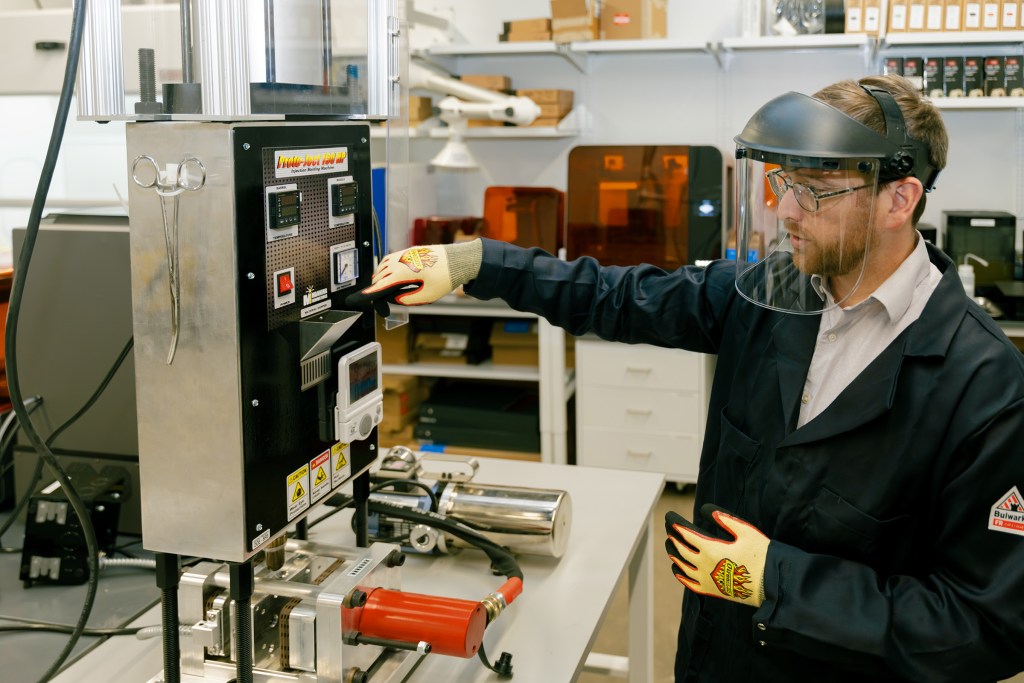
SRNL’s AM capabilities led to SRNL receiving funding for an Interlaboratory Laboratory Directed Research and Development project to create storage capsules for a viable fuel source for generating commercial nuclear fusion energy, deuterium-tritium. Leguizamon considered AM as the ideal approach to creating the capsules because it allows for rapid construction with precision that is difficult to achieve using conventional chemical processing methods.
Leguizamon, and SRNL scientists Camden Chatham, George Larsen, Haley Jones, Holly Flynn and Tyler Guin are creating additively manufactured fuel capsules for fusion that wouldn’t introduce protium impurities during ignition. Utilizing a technique developed by Leguizamon, the team will fabricate lattice architectures within spherical shells approximately 2 mm in size using polyethylene-like materials. Once 3D-printed, the deuterated-polymeric materials are hypothesized to provide more efficient ignition due to their thermal stability, resistance to neutron damage, and lack of plasma contaminating atoms.
SRNL’s Future AM Scope
Though AM is a manufacturing process, it also allows researchers to discover unique chemistries and compositions of materials for polymerization or deconstruction of materials. While exploring novel post-processing techniques for 3D-printing, SRNL researchers discovered a method for deconstructing poly(dicyclopentadiene), a tough polymer used widely for industrial applications. Critically, this method could be applied at room temperature with relatively benign solvents and enabled the recovery of expensive embedded materials such as carbon fiber or microelectronics for recycling and reuse. This capability to recover pristine glass or carbon fibers from poly(dicyclopentadiene) composites has attracted substantial interest from industry, as fiber production—especially carbon fibers—involves energy-intensive manufacturing processes.
SRNL’s recent partnership with a local company that engineers, manufactures, and sells 3D printers and materials provides the opportunity for in-house collaborations as well as industry partnerships. SRNL’s location and proximity to university partners including Georgia Tech, University of South Carolina, Clemson, University of Georgia and South Carolina State University positions SRNL to collaborate with students and solicit new prospectives and innovative solutions as well as prepare the next generation of AM researchers.
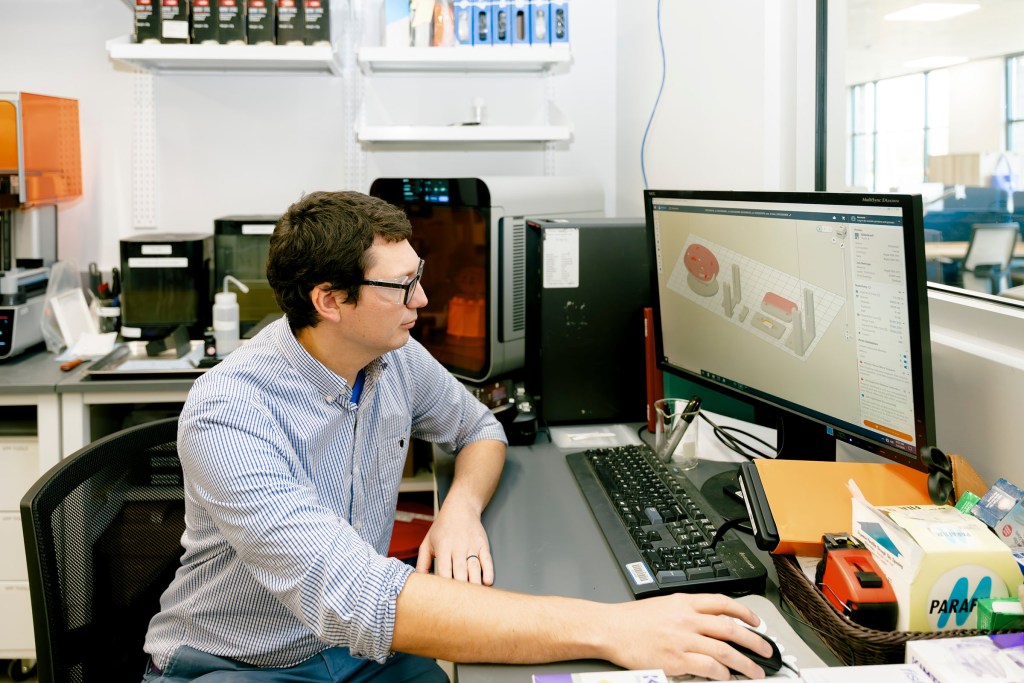
SRNL is also gaining traction in multi material printing. In traditional manufacturing, parts are produced separately and then manually combined. Multi material printing enables the fabrication of objects using two or more different materials simultaneously, creating complex, multifunctional parts. This manufacturing process enables the creation of parts with diverse material properties within a single print. With multi material printing, products can be more seamless and gradient-like, enhancing the quality and functionality of the final product. Increased functionality provides the opportunity to add unique property enhancers like improved strength, flexibility, or conductivity within specific areas of a single part optimizing the final product’s performance.
SRNL is a versatile research and development hub, where skilled scientists and engineers address some of the nation’s most complex challenges. SRNL’s AM resources and expert personnel make it the ideal lab to counter evolving challenges with innovative solutions layer by layer.