
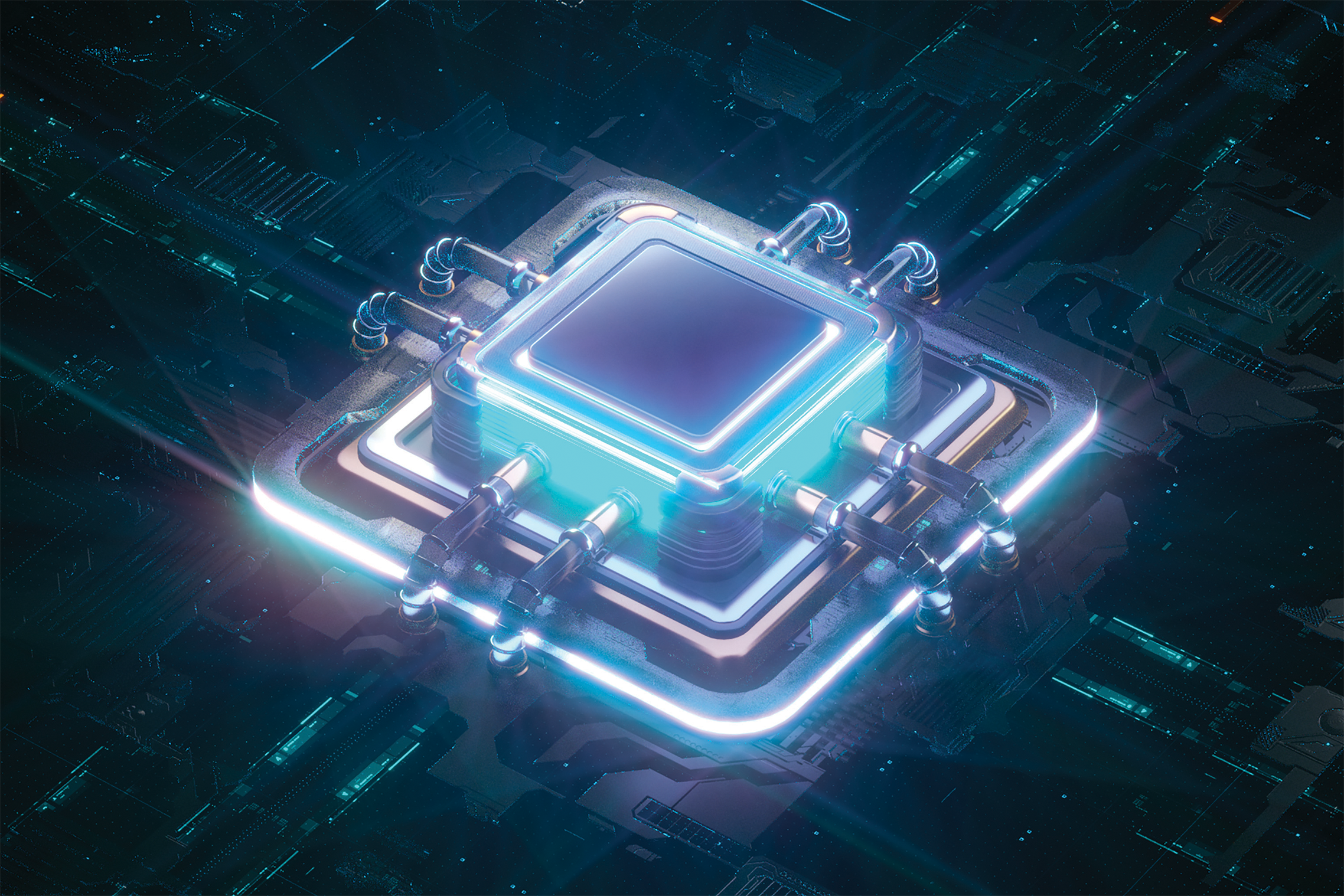
Illustration: Alphonzo James, SRNL
We all rely on computers as part of our daily personal and professional lives. From engineering to plumbing, hardly a single walk of life is unaffected by desktop computers and handheld devices. The advances in computing capabilities over a few short decades have been staggering. The speed and storage capacity of a typical office computer in 2025 is orders of magnitude greater than computers in the 1990s. It is widely known that the smart phone in your pocket has more computing power than the machines that sent the United States to the moon in the 1960s and 1970s. However, one thing has remained constant during this evolution in computing: information and data have all been based on ones or zeros, or binary bits.
A new type of computing called quantum computing is changing this longstanding archetype. Quantum computing is based on qubits, which can exist in a superposition of both the 0 and 1 states simultaneously. Qubits can interact with each other through a phenomenon known as entanglement, allowing quantum computers to process certain complex problems more efficiently than classical computers. This combination of superposition and entanglement provides vast computational capabilities.
A group of computer scientists at Savannah River National Laboratory is at the forefront of this quantum computing revolution. SRNL computer scientists Larry Deschaine and Chris Sobecki are leading the charge. “Things that could actually take centuries on a classical computer can now take minutes or even seconds with quantum computers,” said Deschaine. “Quantum computing is becoming a reality sooner than many thought.”
Deschaine was brought to SRNL to work primarily with artificial intelligence and says that quantum computing is under the lab’s AI umbrella. AI can be achieved using quantum computing algorithms. As quantum science and AI grow, so does the need for the workforce to develop these advances. SRNL is poised to provide that well-trained workforce. Quantum subject matter experts will be needed.
“It can take years to train someone in quantum computing,” Deschaine indicated. “The need for literally millions of quantum computing scientists will be there, so we want to help create a quantum-enabled workforce that can do the AI.”
SRNL is not only training the quantum workforce, but is actively deploying the technology to provide solutions to a vast array of problems and scenarios. This includes prototypes for detecting attacks to the power grid as well as predicting hurricane and tornado development, path and strength. There are several applications in the medical field as well. This includes drug design and molecular science. Quantum computing can also aid in fusion energy science, another area of emphasis and expertise at SRNL. Deschaine has given presentations to business groups touting quantum computing’s ability to optimize logistics and supply chains, enhance risk management and accelerate materials discovery.
Although quantum computing has distinct advantages over classical computing in certain use cases, the two are often used in a hybrid approach to maximize the outcome. SRNL has some classical computer codes for AI and machine learning that have worked tremendously well. Quantum can be used to augment the classical approach or provide select improvements.
“More often than not, it’s the hybrid – the classical plus the quantum – that provides the best accuracy,” said Deschaine. “So, we need to decide if the ensemble of both types, the advantages of each type, works best to solve a problem. And sometimes classical is best, as I don’t need quantum computing to create a Word document.”
While the approach is critical to each use case, the availability of the physical hardware is paramount as well. Though they are becoming more common, true quantum computers are still rare and highly expensive. Private companies are investing large sums of money into quantum computing and the necessary hardware.
Other challenges with quantum computing remain – current technology still faces significant challenges in being deployed at scale for widespread use – and the aforementioned need for the workforce is an obstacle. Colleges and universities are now beginning to offer courses in quantum computing. Deschaine hopes that these institutions can align their curricula with what the national laboratories and the nation need.
The goal is to continue to build a trained workforce to determine appropriate applications, implement the algorithms and provide quantum advantage solutions to relevant use cases.
“The rewards are incalculable,” said Deschaine. “If SRNL can put quantum science to work to do computing better, faster and cheaper, we can create some fantastic things.”