
Re-imagining Workplace Safety: How SRNL is Advancing Safety Through Automation
“Using our rapid prototyping and state-of-the-art machining capabilities allowed us to quickly manufacture and improve the components needed for automation.” – Rodrigo Ramon
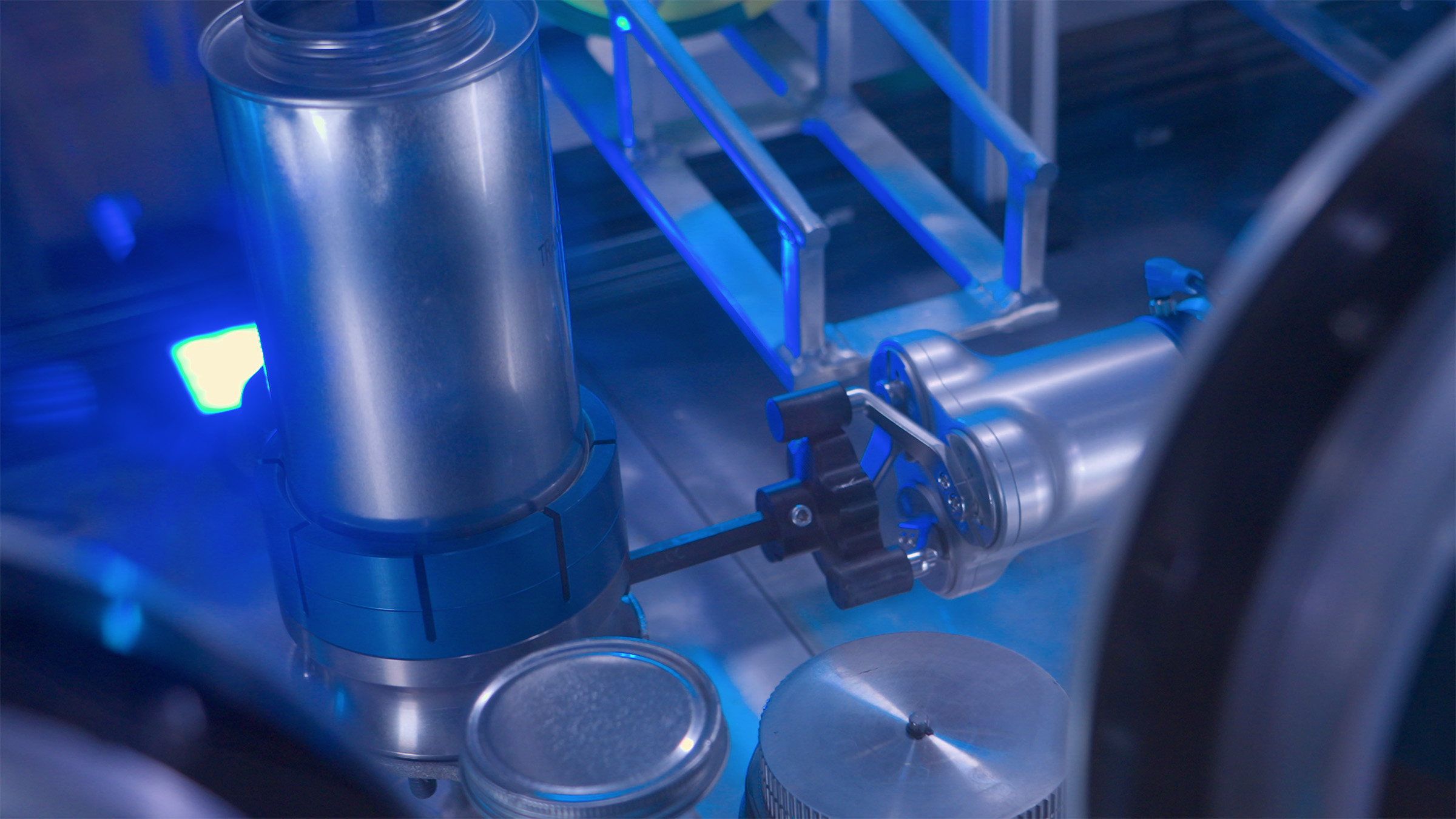
Throughout Department of Energy facilities, personnel routinely perform specialized tasks in gloveboxes — sealed, enclosed workspaces — that protect personnel from radiological materials. While these enclosures provide a critical layer of protection, operators can still be exposed to radiation and suffer injury from repetitive motions and awkward positioning.
To overcome these obstacles, researchers at Savannah River National Laboratory are developing robotic and automation technologies to increase operational efficiency and create safer, more ergonomic working conditions. This effort supports the missions of the Department of Energy’s Office of Environmental Management and the National Nuclear Security Administration by reducing worker exposure and enhancing safety in some of the most demanding environments.
Integrating Robotics into the Glovebox
SRNL is accustomed to utilizing robotic technology to improve efficiency and worker safety. In 2021, SRNL partnered with Sandia National Laboratories to develop wearable tools to prevent injury and muscle fatigue. SRNL also employs Boston Dynamics’ Spot, a dog-like robot monitoring device, to provide operational awareness to reduce exposure to radiation and other hazards.
SRNL’s newest automation project differs from previous technology in that it integrates a collaborative robotic arm into a nuclear glovebox system. Using a commercially available Universal Robots UR5e Collaborative Robot Arm, researchers customized the system to operate within existing infrastructure without requiring major modifications to the structure of the glovebox.
“We started by developing a direct mockup of an existing process, along with all the interior tools and elements within the glovebox,” said SRNL engineer Rodrigo Ramon. “Then we retrofitted the tools without modifying the glovebox itself to enable automation.”
The project focuses on automating repetitive portions of plutonium handling and processing operations. While the system automates only part of a larger workflow, it demonstrates how robotics can successfully be integrated into nuclear operations while maintaining productivity.
SRNL’s approach emphasizes collaboration between humans and machines. The system uses a collaborative robot, or “cobot,” specifically designed to operate alongside people. These robots feature built-in collision detection and avoidance systems that continuously monitor for abnormal conditions. If an unexpected interaction occurs, the robot immediately stops to prevent injury or damage. Currently, the robotic arm helps alleviate potential radiation exposure by performing many repetitive manual tasks while operators supervise the process and advance operations as needed.
Solving Unique Challenges
Unlike traditional manufacturing environments, glovebox operations are difficult to precisely replicate. Small changes in equipment positioning and consumable materials can occur over time, creating challenges for automated systems. In response, SRNL developed adaptive programming techniques that allow the robot to continuously recalibrate itself using reference points located throughout the glovebox. These capabilities allow the robot to perform tasks repeatedly and consistently, even when minor shifts occur, ensuring the precision required for nuclear operations.
“Robots are easy to set up and program for generic applications,” said Ramon. “But their physical location must be optimized for the process, and special considerations must be made for glovebox operations.”
SRNL’s advanced machining capabilities allowed researchers to address those challenges by developing specialized tooling and support equipment tailored to the operating environment. “We spent a lot of time developing custom tools and adapters,” said Ramon. “Using our rapid prototyping and state-of-the-art machining capabilities allowed us to quickly manufacture and improve the components needed for automation.” This ability to rapidly iterate designs helped accelerate development while allowing the team to identify and solve challenges throughout the process.
An advantage of creating in-house parts is building dependability into the design components. To prevent operational downtime from impacting production schedules, engineers-built maintenance and repair capabilities directly into the system. Everything installed within the glovebox can be serviced or replaced. The team developed custom in-glovebox hoists and support systems that allow operators to lower, move, or remove the robotic arm when necessary. This design ensures that automation enhances operational resilience rather than creating additional risk.
Looking Ahead
“What I like is the technical challenge of robot programming and finding creative solutions to solve difficult problems,” said Ramon. “Bridging the gap between what humans and robots excel in is the main challenge and goal of automation development.”
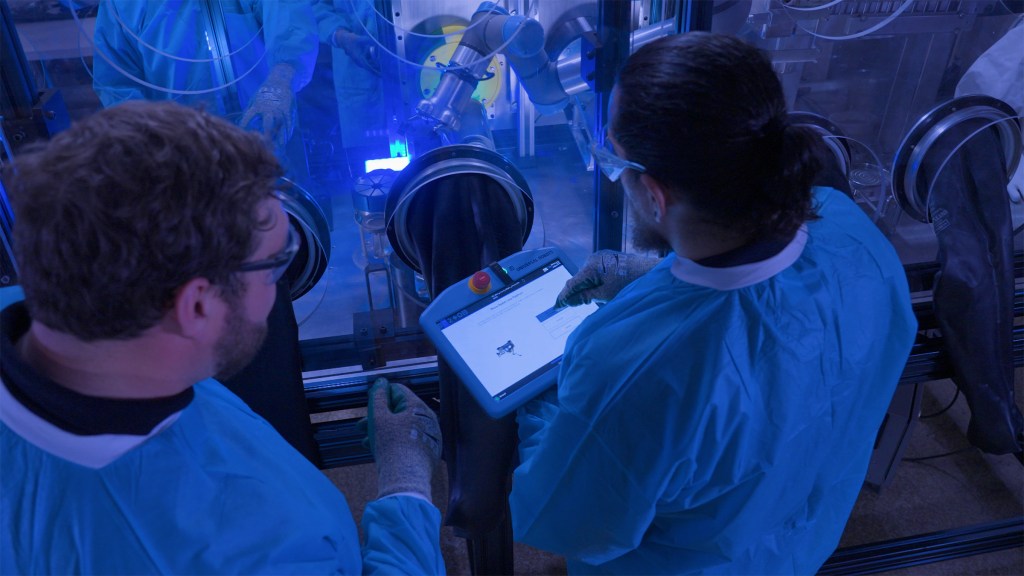
As the project continues, SRNL researchers see opportunities to apply their experience across a broader range of government missions and nuclear applications. “If we can prove robotic arms are viable in nuclear glovebox applications at a small scale, that builds confidence for their application to other missions,” said Ramon.
This effort represents more than a single automation project. Combining human knowledge and skill with robotic precision helps SRNL modernize nuclear operations while improving safety and mission performance. As automation technologies continue to evolve, these efforts are laying the foundation for the next generation of nuclear operations.