
SRNL’s Collaborative Partnerships Drive Innovation in Environmental Stewardship
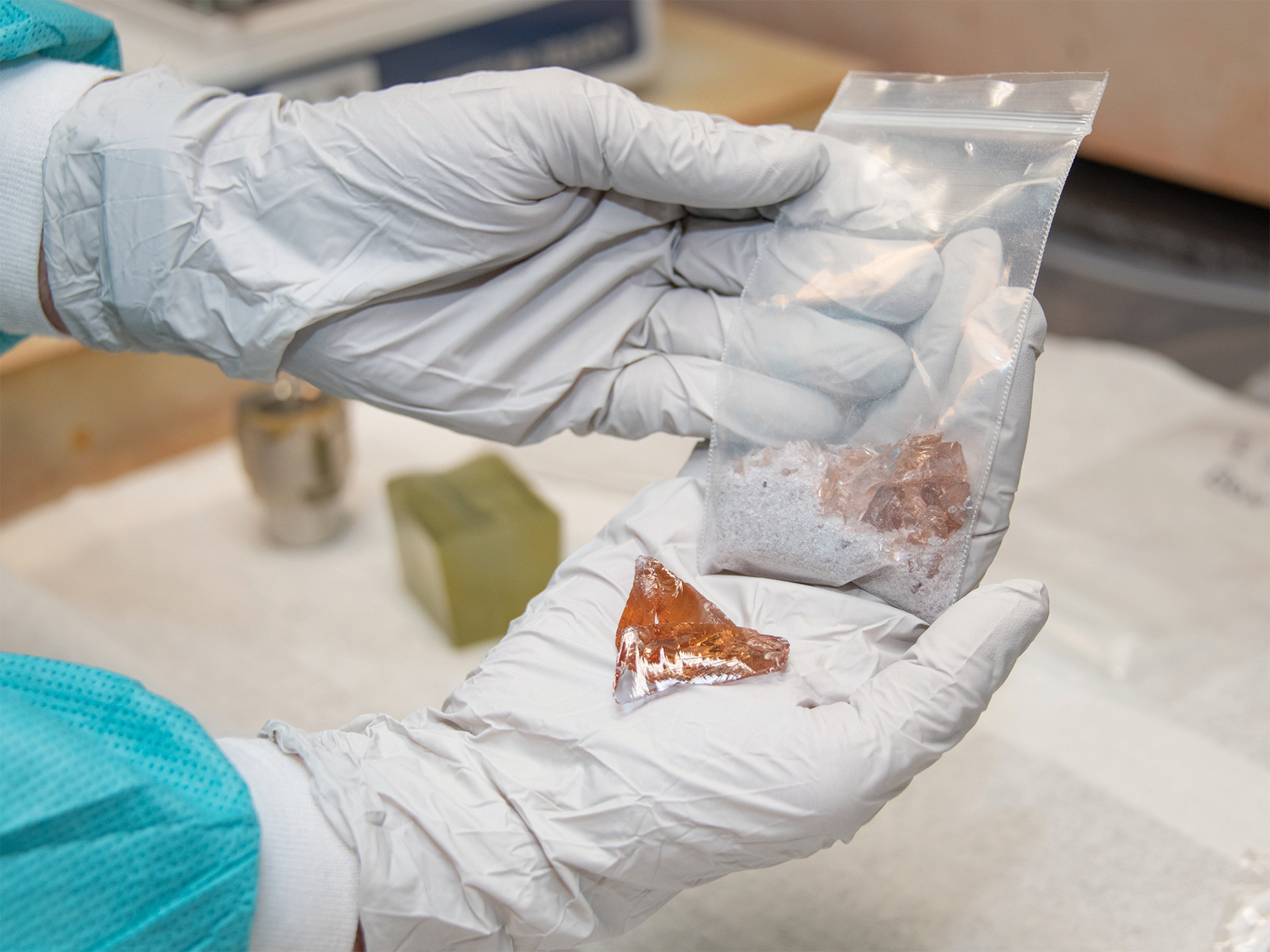
Samples of vitrified waste. (Photo: Laura Russo, SRNS)
While partnerships across industry, academia and the Department of Energy complex are a critical component of Savannah River National Lab’s future, they also served as a foundational element throughout the lab’s history. The 1989 Tri-Party Agreement between the DOE, the Washington State Department of Ecology and the U.S. Environmental Protection Agency brought attention to the critical need for cleanup at the Hanford Site. The decision to pursue vitrification of the waste was in alignment with efforts already underway at SRNL providing an ideal opportunity to continue collaboration with the Hanford Site on waste cleanup and compliance.
Tank Waste Remediation System
The Tank Waste Remediation System program began in the early 1990s, strengthening SRNL’s working relationship with the Hanford Site and continuing the long-standing relationship with the Pacific Northwest National Laboratory (PNNL). At that time, SRNL was primarily focused on glass formulation and melter technology research and development to support the development of Hanford’s waste vitrification facility. By the late 1990s, DOE established the Focus Area program to conduct waste treatment research and development across the DOE complex. The Tank Waste Focus Area facilitated collaboration on tank waste research at Hanford and the Savannah River Site.
By the early 2000s the DOE’s Office of River Protection was established to oversee remediation and waste treatment efforts at Hanford. Several employees from SRS and SRNL transitioned to Hanford to provide support for other contractors on the new Waste Treatment Project (WTP). The WTP research and development program was intended to provide validation for the pretreatment, low-level and high-level vitrification facilities to be conducted at Hanford. Several employees at SRS and SRNL were chosen to go to Hanford to be involved with waste treatment projects. Simulant testing was conducted at SRNL in support of the program. This included near full-scale testing on filtration, precipitation, ion-exchange, mixing and vitrification processes. Actual waste samples were also shipped to SRNL facilities to demonstrate treatment of real waste. Research and testing spanned approximately 5 years. The results were used to validate the process outlines, known as flowsheets, selected by Hanford and to predict challenges the facility could face when brought online.
Large C-Melter
As the tank waste remediation system was being developed, additional SRNL scientists and engineers were leveraging their expertise to support the design and planning of a small-scale melter for testing with actual radioactive samples of Hanford tank waste. The objective was to produce kilogram quantities of waste-containing glass for characterization of metals and radionuclides capable of being archived for regulatory characterization within a continuously fed, resistance heated melter known as the “Large C Melter.” The sample that was vitrified had been subjected to complete pretreatment at SRNL including strontium/transuranics precipitation, filtration to remove entrained solids, cesium and technetium removal by ion exchange and concentration by evaporation. Once the pretreatment process was complete resulting in ~ 6.7 liters of concentrated supernate, glass formers were added to create the melter feed. The glass former recipe was sourced from the Vitreous State Laboratory at the Catholic University of America, who SRNL collaborated with to conduct glass formulation work through sharing of analytical data from samples.
As melting begins, it is critical to sample and analyze the offgas (the release of gas that is produced from heating up and melting the aqueous slurry melter feed material) for metal and radionuclides through EPA methods. Offgas samples must also be analyzed for fixed gasses, organics and combustion gasses to ensure safety standards. SRNL provided support in offgas testing for safety and compliance, which culminated in a 2002 report describing melter tests, glass characterization, offgas analyses and rheology testing of the Large C concentrate and melter feed slurry.
SRNL scientist Charles Crawford was involved in the project from inception. “To do processing on this scale in the late 1990’s was a unique opportunity,” said Crawford. “No other pretreatment or vitrification samples were performed on this scale at the time. It also provided the opportunity to learn more about Hanford’s system and provide analysis of data to positively impact the design and development of their melter. SRNL uniquely possesses both the necessary facilities and the technical expertise required to support Hanford’s efforts, which would’ve been difficult to find elsewhere at that point in time.”

A portion of the Large C Melter (Photo: SRNS)
Pretreatment Facility
SRNL became more closely involved with Hanford’s pretreatment facility technical issue resolution in 2000. The baseline Waste Treatment and Immobilization Plant flowsheet included sending tank waste to the pretreatment facility as a supernate stream, the liquid found above the sediment in a solution, and a slurry stream, a mixture of solid particles suspended in a liquid. The first step of the pretreatment process was to combine these two streams. Step two involved filtration to separate the supernate stream, which would eventually be sent to an additional facility. Before the stream could progress, cesium and solids would be removed, lowering the radioactivity so this could be treated as low-level waste. At this point, the resulting low-level waste would typically be solidified as grout. Grout is cost-effective to incorporate and unlike vitrification, will capture water and is thus a closed system. It’s also a simple process that can be stopped and started without a negative impact to the final product.
Through SRNL’s supporting analysis, it was determined that the pretreatment facilities mixing technology was not suited for mixing slurries.

The Low-Activity Waste Facility in Hanford, Washington. (Photo: Bechtel)
Low Activity Waste (LAW) Facility
The concept of a Tank Side Cesium Removal facility was introduced to initiate waste processing with a modular system that could execute the filtration and cesium removal steps to produce low activity waste. The new facility was physically smaller but had a similar throughput. SRNL has a similar tank side system for treating waste.
“Tank waste processing efforts at the Savannah River Site have allowed SRNL to compile decades of knowledge and expertise,” said SRNL engineer Mike Stone. “We want to leverage that experience to support efficient and effective tank waste treatment at Hanford.”
“SRNL has played a critical role in the success of the Hanford Low-Activity Waste vitrification mission at the Waste Treatment Plant,” said SRNL scientist Rich Wyrwas. “Hanford has pursued a more complex approach to treat all its waste through a vitrification facility, driven in part by commitments made to stakeholders. SRNL’s role has been to bring hard-earned lessons from other successful DOE projects forward, to help Hanford navigate its technical challenges and to demonstrate that collaboration and support from across the DOE complex can make national missions more achievable.”
From 2016 through today, SRNL has been involved with various ongoing projects alongside Hanford. The lab was involved in a panel that developed an integrated control strategy for Hanford’s facilities to ensure key facilities effectively communicated with each other. The panel also explored concerns for corrosion in Hanford’s LAW facility. SRNL has provided analysis of corrosion samples and glass composition samples from the melter to determine potential impacts and opportunities for improvement.
In addition to the tank corrosion work, SRNL is also collaborating with Hanford on their glass compositions and potential corrosion impacts of those compositions within the melter. SRNL led two teams from the Network of National Laboratories for Environmental Management Stewardship to support waste treatment efforts at Hanford and continues to share knowledge and experience through peer-reviews of work by Hanford scientists and engineers. These teams led to re-evaluation of grout alternatives for the low-activity portion of the waste using options not available at the start of the Hanford mission, and a technology R&D roadmap that could save tens of billions of dollars and many years on the tank waste mission.
Though the shape of the partnership continues to evolve, the spirit of collaboration helps drive SRNL’s mission of environmental stewardship and directly impacts the success of the national lab system and the DOE complex.