
Accelerated Analysis: SRNL Scientists Advance Technique for Rapid Chemical Detection
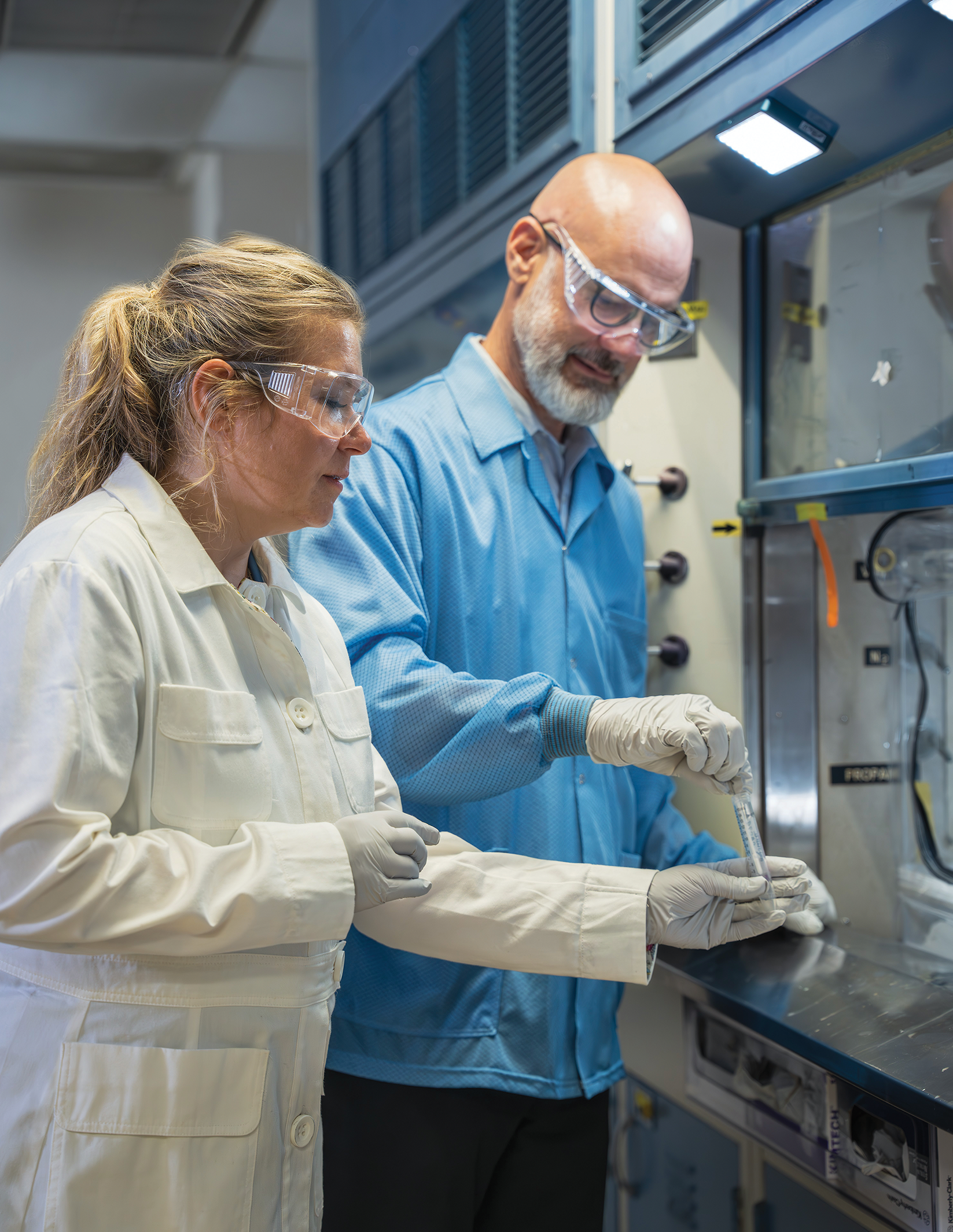
SRNL radiochemist Ashlee Swindle and Guido Verbeck, Augusta University joint appointees are working together to provide proof of
concept using non-radiological surrogates and ultimately reduce analysis for isotopes. (Photo: Chance Briley, SRNS)
The paper spray ionization (PSI) technique, coupled to a high-resolution ambient mass spectrometer, is widely used for health care diagnostics, drug detection, pharmaceutical development, and food safety by organic fingerprint analyses. Through research supported by the Laboratory Directed Research and Development program at Savannah River National Laboratory, a team of scientists realized the advantages and opportunities of using PSI for analyzing inorganic actinides, demonstrated for uranium. The team has now developed a cost-efficient and time-saving process that is positioned to become the go-to process for the future.
“Uranium enrichment has yet to be demonstrated using PSI, so we are one of the first to use this technology to expedite the analysis,” said John Kelly, SRNL scientist and one of the principal investigators on the PSI team. The work was recently highlighted on the cover of the Journal of the American Society for Mass Spectrometry.
The PSI process begins with placing a sample on a type of substrate, like a paper wedge. The substrate is then inserted into the instrument, and within minutes, isotopic signatures are detected and assessed. The ease of collecting samples from very small quantities, like through subsampling from any surface, is what makes this method an open door for future opportunities.
Typically, milligrams of solids or milliliters of solution are necessary to characterize isotopes of interest such as uranium, but with PSI, the sample can be as small as eight microliters. A micro-liter is one millionth of a liter and about the size of a single salt crystal. Samples of that size don’t require upfront chemistry that could take days to weeks to complete.
“This truly is a valuable rapid screening tool that is applicable both in the laboratory and out in the field,” said Ashlee Swindle, SRNL radiochemist and PI. “You can collect samples in an emergent fashion, or you can do things more methodically in a fixed laboratory setting, and you would still get your results in about five minutes or less.”
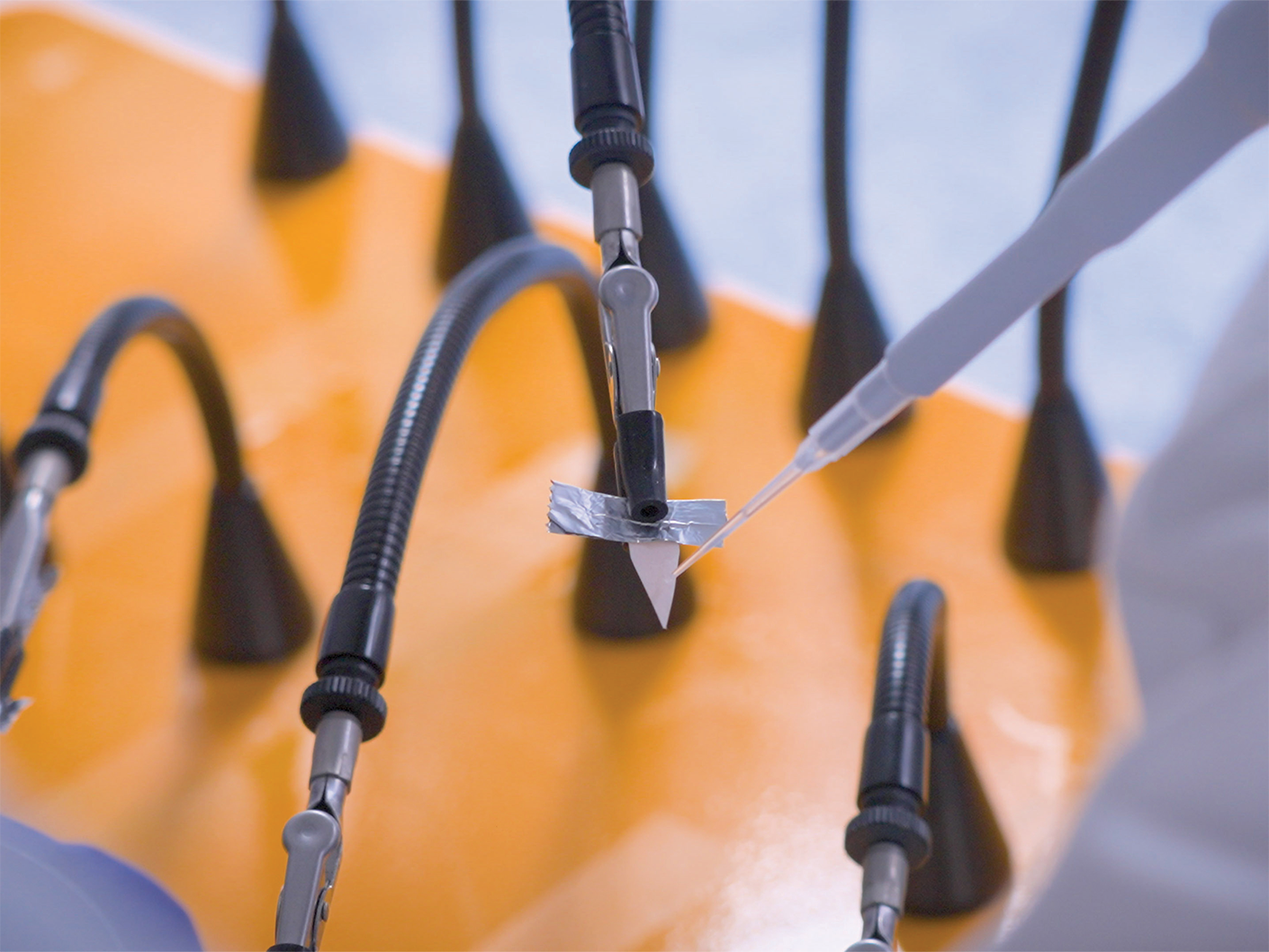
SRNL scientists prepare a sample on a paper wedge to be inserted into the mass spectrometer. (Photo: Brad Bohr, SRNS)
Sending samples away to be tested, whether radiological or non-radiological, comes with a huge cost. Utilizing this capability with already employed field systems and being able to provide analyses in a significantly shorter amount of time eliminates the cost barriers.
The PSI team is partnering with Augusta University through a joint appointment with Guido F. Verbeck, an expert in analytical science with a strong emphasis in mass spectrometry. Together, they will explore inline miniature radiochemical separation of analytes of interest at their original location. The first step is providing proof of concept using non-radiological surrogates, and ultimately reduce analysis for isotopes, like strontium-90, from weeks to minutes.
“To ignite the nuclear energy renaissance, SRNL is accelerating the development and deployment of next generation nuclear technologies. The PSI team is laying the groundwork for expedited analytical support to help pave the way for pilot advanced reactors to achieve criticality by July 4, 2026,” Kelly said. The PSI team is preparing for what’s to come with further development of the capability focusing on fuel recycling and reprocessing.
“If we’re going to lean forward and prepare for the future, we need the capability to reduce complexity, reduce research and development time, and minimize the workforce burden so that people can focus on high-value tasks while automation and artificial intelligence can shoulder the repetitive and time-intensive work,” said Kelly. “If we are serious about supporting the nuclear energy renaissance, ensuring abundant, reliable, and affordable energy for the United States, these types of technologies must be operational today, not tomorrow.”
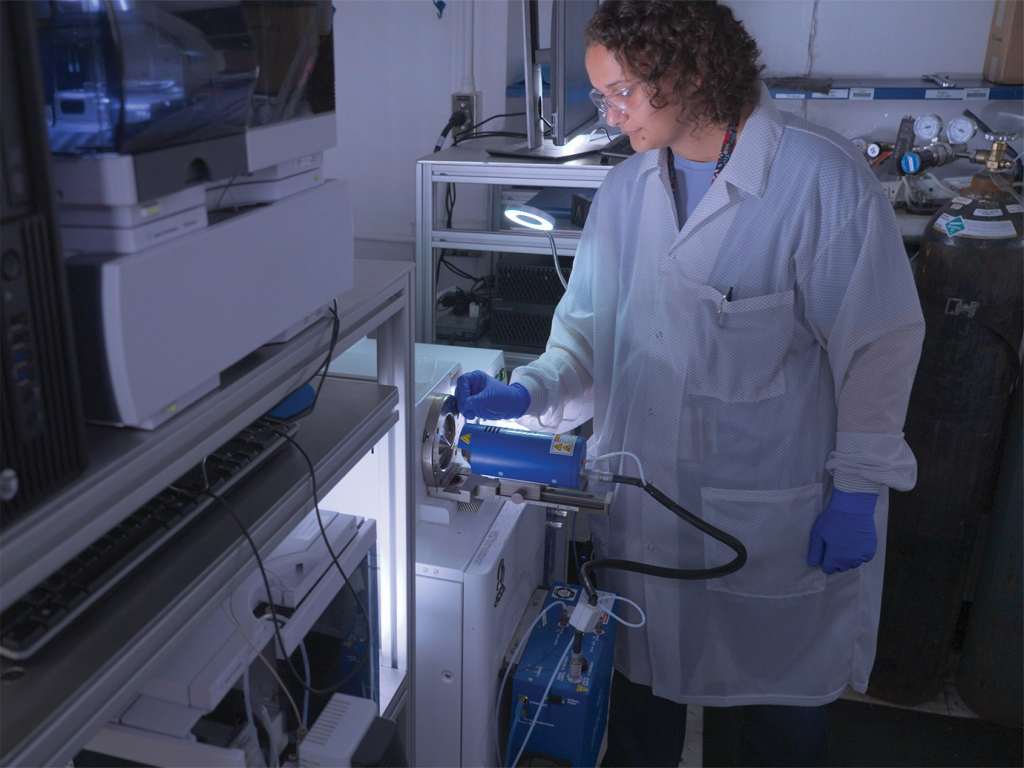
SRNL scientist Katelyn Smith places a paper wedge into the mass spectrometer to perform the paper spray ionization technique. (Photo: Brad Bohr, SRNS)